A Day at Swechha Waldorf: What Learning Looks Like in Our Classrooms
A Day at Swechha Waldorf: What Learning Looks Like in Our Classrooms
Table of Contents:-
- Introduction
- It Starts Before the First Bell
- The Rhythm of the Day
- What Happens Inside the Classroom
- The Teacher's Role: More Than Instruction
- The Teacher's Role: More Than Instruction
- Outdoors, Always
- What Parents Actually Notice
Most parents, when choosing a school for their child, ask the same question — "Will my child be happy here?" Not just occupied. Not just achieving marks on a sheet. Actually, genuinely, happy. And that question matters more than we often admit, because a child who feels safe and joyful in a space learns so much better than one who is simply going through the motions.
At Swechha, we think about that question every single day. And the answer we build — brick by brick, rhythm by rhythm — is a school day that looks nothing like what most of us grew up experiencing.
So let's walk through what a real day here looks like. No ideals, no jargon. Just what actually happens.
A gentle hum replaces the school bell
Children arrive at Swechha the way you'd arrive at a warm home — not a closed gate or an attendance machine. The classroom is already set up with purposeful activity. Beeswax on a table. Wool for knitting. Watercolours drying from yesterday. The space itself tells the child: something good is about to happen here.
This isn't accidental. At a Waldorf school, the environment is treated as a teacher in itself. What the walls hold, what the textures feel like, what the light does in the morning — all of it contributes to a child's sense of ease and belonging.
The Rhythm of the Day
One of the most misunderstood aspects of Waldorf education in Vizag — and globally — is that it's "too free" or "unstructured." That's not quite right. There is tremendous structure. But it's a rhythm, not a timetable.
A Waldorf day breathes. There are moments of concentration followed by movement. Story followed by craft. Indoor calm followed by outdoor play. This isn't just philosophy — it's child development in action. Young children don't compartmentalise learning into 50-minute boxes. Their minds and bodies work together, and a day at Swechha honours that.
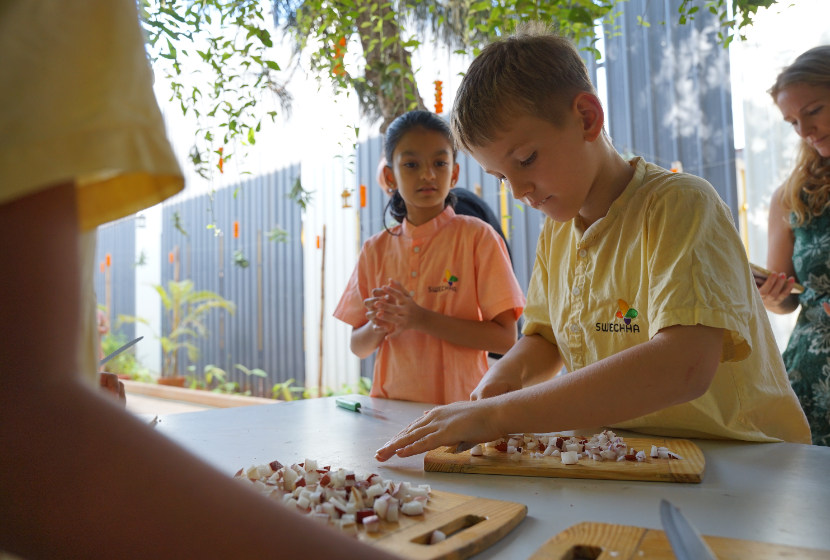
In the kindergarten years, children move through activities organically — singing, circle time, free play, snack preparation, and outdoor exploration. You'll find a group baking cookies one morning and pressing flowers the next. A child who helped roll chapatis yesterday is now counting without realizing. The one who watered the garden understands patience better than any worksheet could teach.
What Happens Inside the Classroom
Here is where it gets genuinely interesting. The Waldorf classroom activities at Swechha are not exercises in sitting still. They are designed to engage the whole child — hands, heart, and head. Rudolf Steiner, who founded Waldorf education in 1919, believed that these three elements must develop together, not in isolation.
So a math concept isn't introduced on a blackboard alone. It might first arrive through a rhythmic clap, a movement pattern, or a story about a merchant counting his goods. By the time a child encounters the abstraction, they've already felt it in their body and met it through their imagination.
In the primary years at Swechha, this comes alive across subjects. Languages are learnt through drama and recitation. Science is met first through observation — watching how water moves, how shadows change, what happens when you mix natural colours. History is told as a story before it becomes a chapter.
There are no textbooks in the early years. Children create their own books — handwritten, illustrated, and deeply personal. That book becomes something they actually want to open.
The Teacher's Role: More Than Instruction
At Swechha, teachers are not performers on a stage. They are guides who work alongside children. In the kindergarten especially, the teacher demonstrates — cooking, sewing, painting, gardening — and children learn through imitation, which is the most natural mode of learning for young ones.
This is why Swechha is considered among the best kindergarten schools in Visakhapatnam by families who have experienced the difference. When a child spends their early years in a space where the adult is genuinely doing something meaningful — not just managing a classroom — the child absorbs not just the skill, but the attitude. The care. The attention.
Outdoors, Always
Rain or shine (well, mostly), children at Swechha spend meaningful time outdoors. The campus at Rushikonda, nestled within GITAM University, offers open green spaces. The Pedda Waltair campus has its own garden charm — flowers, a fish pond, the particular kind of noise that only comes from children running freely.
Outdoor time isn't a break from learning. It is learning. Balance, coordination, risk-taking, negotiation with other children, weather, insects, mud — all of it feeds a child's development in irreplaceable ways.
What Parents Actually Notice
Families who join Swechha often say the same thing after a few months: "My child is different." Not in a big, dramatic way. But quieter. More curious. Less likely to give up on something hard. More likely to sit with a task until it's done.
That's what a day at Swechha builds — not just knowledge, but a relationship with learning itself.
And honestly, that's the thing that stays with a child long after they've grown up and forgotten what grade they were in when they learnt to multiply.