A Safe Place to Grow: Balancing Protection, Freedom and Responsibility
A Safe Place to Grow: Balancing Protection, Freedom and Responsibility
When parents choose a school, safety is understandably one of their first concerns.
Is the campus secure? Are children supervised? Is the school prepared to respond when something goes wrong? Are the classrooms and play spaces safe?
These are important questions. But there is another question that is equally important:
Does the school help children learn how to keep themselves safe?
At Swechha, we believe that safety is not only about creating an environment where children are protected by adults. It is also about gradually helping children develop awareness, judgment, responsibility and self-regulation.
As a Swechha Waldorf Inspired school, we believe children need both protection and freedom—the freedom to explore, move, make choices, experience manageable challenges and gradually understand the consequences of their actions.
For us, the goal is not to remove every possible difficulty from a child's environment. It is to create a safe enough environment in which children can learn to navigate the world with growing confidence.
Safety Is More Than Physical Security
A school has an obvious responsibility to protect children physically.
There must be appropriate supervision, safe infrastructure, clear procedures and responsible adults who know how to respond to situations that require intervention.
But childhood also involves learning to judge situations.
A child needs to learn:
- When should I slow down?
- How close can I stand to another person?
- What happens when I run without looking?
- How do I use equipment responsibly?
- What should I do when I feel uncomfortable?
- How do I recognise when another child needs space?
- When should I ask an adult for help?
These are not lessons that can be learned simply by being told what not to do.
Children develop these capacities through experience.
That is why we believe that a truly safe school environment should not only prevent children from encountering every risk. It should also help them develop the capacity to recognise and respond to risk appropriately.
The Balance Between Protection and Freedom
Children need adults to establish boundaries.
They also need opportunities to experience what it means to operate within those boundaries.
Imagine a child learning to climb.
One approach is to remove anything that could possibly cause a fall.
Another is to allow the child to climb without guidance.
Neither is ideal.
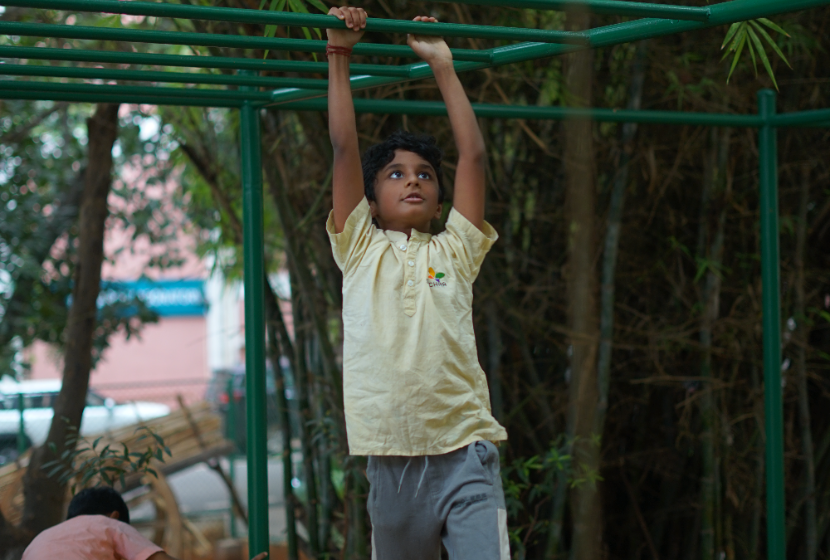
The thoughtful approach is to provide an environment where the child can climb with appropriate supervision, understand the limits, experience the challenge and gradually learn to judge what they are capable of.
This is the balance we seek at Swechha.
Freedom without boundaries can become unsafe.
Boundaries without freedom can prevent growth.
Children need both.
Why Freedom Matters in Childhood
Children are naturally curious.
They want to explore their surroundings, test their physical abilities, interact with other children and discover what happens when they try something new.
This exploration is not separate from learning. It is learning.
In a Waldorf-inspired education, movement, imagination, practical activity and free play have an important place in the child's development.
At Swechha, Vizag's first Waldorf school, we therefore think carefully about how children experience their environment.
We want children to have opportunities to move, play, create, explore and interact—not simply sit in spaces where every possibility of difficulty has been removed.
A child who is always rescued from every small difficulty may remain dependent on an adult's judgment.
A child who is given appropriate freedom, with an attentive adult nearby, begins to develop their own judgment.
That is an important part of growing up.
Learning to Take Responsibility
Responsibility develops gradually.
A young child cannot be expected to regulate themselves in the same way as an older child. Early childhood requires significant adult guidance and co-regulation.
But over time, the adult's role changes.
We move from:
“I will keep you safe.”
to:
“I will help you understand how to stay safe.”
And eventually:
“You are able to make responsible choices.”
This progression is central to how we think about education.
Teachers establish clear expectations, model appropriate behaviour and intervene when necessary. At the same time, children are given opportunities to make choices, solve problems and repair situations when things do not go as planned.
The objective is not obedience for its own sake.
It is the development of inner responsibility.
What Happens When Children Make Mistakes?
Children will make mistakes.
They will run too fast, misjudge a situation, argue with a friend, fall while playing or sometimes make an impulsive choice.
A school that aims to completely eliminate mistakes may unintentionally eliminate some of the experiences through which children learn.
This does not mean that adults ignore unsafe behaviour.
Quite the opposite.
When intervention is needed, teachers step in. But whenever possible, the situation also becomes an opportunity for reflection:
What happened?
What could we have done differently?
Who was affected?
How can we make it right?
This helps children move beyond simply fearing consequences.
They begin to understand consequences.
That difference is significant.
Safety and Self-Regulation
One of the most important forms of safety is the ability to regulate oneself.
A child who can recognise that they are becoming overwhelmed, pause before reacting, respect another person's physical space and seek help when needed is developing an important life skill.
Self-regulation does not appear overnight.
Children first borrow the regulation of adults around them. Calm adults help children become calm. Predictable routines help children feel secure. Clear boundaries help children understand what is expected.
Over time, with repeated experience and guidance, children begin to internalise these capacities.
This is why the environment matters so much.
The classroom, playground, relationships, rhythms and expectations of a school all contribute to the child's development of self-regulation.
A Safe Environment Does Not Have to Be Fearful
Sometimes, in our desire to keep children safe, we can unintentionally communicate that the world is dangerous.
“Don't run.”
“Don't climb.”
“Don't touch that.”
“Be careful.”
“Don't go there.”
Of course, there are situations where these words are necessary.
But childhood should not become an endless list of warnings.
Children also need to hear:
“Try.”
“See what you can do.”
“Can you figure it out?”
“Watch your step.”
“Would you like to try again?”
“What do you notice?”
The language we use communicates our trust in children.
We want children to experience the world as a place that deserves awareness and respect—not as a place that must be feared.
The School Environment Teaches Too
A school does not educate children only through its curriculum.
The physical environment teaches.
The way adults respond to conflict teaches.
The amount of freedom children are given teaches.
The way mistakes are handled teaches.
The way boundaries are established teaches.
The way children are expected to care for their belongings, classrooms, materials and one another teaches.
This is particularly important when choosing a primary school in Vizag. Parents are not simply choosing classrooms and subjects. They are choosing an environment in which their child's habits, relationships and sense of responsibility will develop every day.
Choosing a School That Grows With Your Child
A good school should be able to change its approach as children grow.
A five-year-old needs more adult guidance.
An eight-year-old can begin to take greater responsibility.
An older child can be expected to make increasingly thoughtful decisions and understand the consequences of those decisions.
The aim is not to keep children dependent on adults for safety indefinitely.
The aim is to gradually make the adult less necessary.
This is one of the deeper purposes of education: to help a child become capable of standing on their own feet.
For families looking for a Waldorf school in Vizag, this is an important aspect of the educational philosophy to consider. A Waldorf-inspired approach does not mean leaving children entirely to their own devices. It means creating age-appropriate conditions in which children can develop through experience, relationship, rhythm, movement, imagination and increasing responsibility.
A Safe Place to Become Independent
At Swechha, we want children to feel secure enough to explore and supported enough to take risks appropriate to their age.
We want them to know that adults are there when they need help.
We also want them to gradually discover that they are capable of handling more and more on their own.
That is why we think of safety not as a wall around childhood, but as a foundation beneath it.
Protection gives children security.
Freedom gives them experience.
Boundaries give them direction.
Responsibility gives them independence.
When these come together, children can grow into people who are not merely kept safe by others, but who know how to care for themselves, care for others and navigate the world with awareness.
That is the kind of environment we aspire to create at Swechha—a safe place not simply for children to be protected, but for them to grow.
Swechha is a Waldorf-inspired school with campuses at Rushikonda (GITAM University) and Pedda Waltair, Visakhapatnam. To attend a parent orientation or learn more, visit swechhawaldorf.in.