Grade One - The beginning of Learning
Grade One - The beginning of Learning
Table of Contents
- Introduction
- Why Age Six Matters
- Building Bridges Between Learning Stages
- Supporting Your Child Through the Transition
- The Swechha Approach to Grade School Readiness
- Looking Forward: What Comes After Kindergarten
There's a moment every parent knows well. Your child, who just yesterday seemed so small, suddenly stands at the threshold of something bigger. The transition from those playful kindergarten years to formal grade school feels monumental, doesn't it? You might wonder if they're truly ready. Will they adjust? Can they handle the shift from storytelling circles to structured lessons?
These questions are natural. After all, moving from one phase of learning to another isn't just about changing classrooms; it's about transitioning to a new level of understanding. It's about honoring where a child has been while preparing them for where they're going.
At Swechha, we've watched countless children make this journey. As Vizag's first school inspired by Waldorf philosophy, we understand that kindergarten to grade school education isn't a leap. It's a gentle unfolding, much like watching a bud become a flower. The key lies in recognizing when the child is developmentally ready, not when society says they should be.
Why Age Six Matters
Most kindergartens in Visakhapatnam rush this transition. Children are pushed into academic learning at four or five, expected to master reading and writing before their brains are truly prepared for abstract thinking. But here's what decades of educational research and Waldorf practice have taught us: premature academics often backfire.
Between ages three and six, children learn best through imitation, play, and sensory experiences. Their brains are wired for imagination, movement, and exploration. At six, something shifts. The child naturally begins showing signs of academic readiness: losing baby teeth, slower breathing, readiness for instruction, and an appetite for formal concepts.
This is why the best kindergarten schools in Visakhapatnam wait until children turn six before introducing a formal Grade 1 curriculum. Rushing this transition steals something precious from childhood. We've seen the difference ourselves. Children who spend their early years playing with natural materials, hearing rich stories, and moving freely arrive at Grade 1 confident, curious, and genuinely eager to learn.
Building Bridges Between Learning Stages
The shift from kindergarten to grade school shouldn't feel like entering a different world. At Swechha, we design the transition to feel continuous. Our Waldorf grade school in Vizag maintains the warmth and rhythm children know from their kindergarten years while gradually introducing academic content.
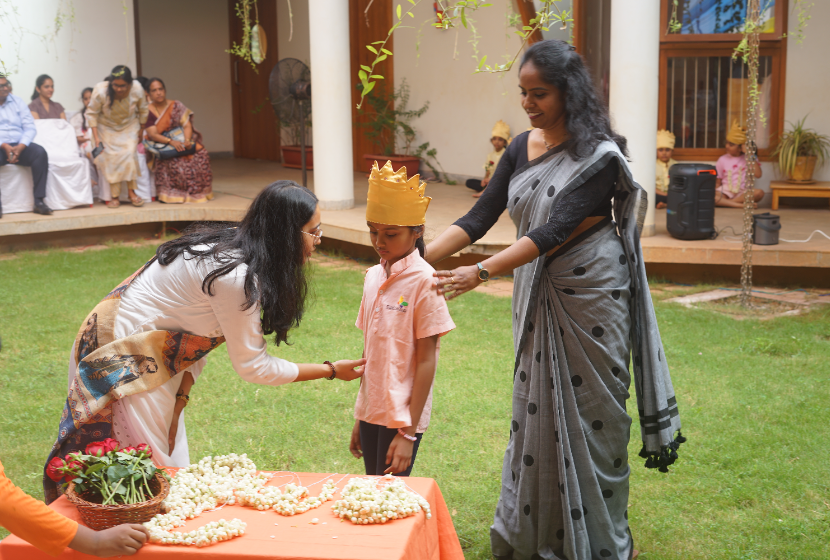
Swechha’s rose ceremony makes this huge transition a beautiful journey for children. The Kindergarten teacher hands over the child to the receiving Grade school class teacher by adorning them with crowns. The new Grade school teacher welcomes the child into their embrace with garlands.
Grade 1 still includes movement, music, art, and storytelling. But now these activities serve new purposes. Stories become gateways to language and writing. Movement games introduce mathematical concepts. Painting and drawing help children form letters and numbers with joy rather than pressure.
Teachers in the best grade schools in Visakhapatnam often focus solely on academic achievement. We focus on the whole child. Yes, children learn to read, write, and calculate. But they also continue developing emotionally, socially, and physically. A child who feels secure and valued learns more effectively than one who feels anxious about performance.
Supporting Your Child Through the Transition
Your role during this transition matters more than you might think. Here's what helps:
-
Create Positive Associations
Start conversations about grade school naturally. Share your own positive school memories. Avoid associating grade school or class teacher with fear, rules or discipline. It should be a place the child looks forward to exploring and learning with joy.
-
Maintain Home Routines
Children transitioning to grade school need predictable rhythms: regular bedtimes, unhurried mornings, screen-free days, time for free play. Structure doesn't mean rigidity. It means creating a safe container where children can grow.
-
Trust the Timeline
Some children adjust instantly. Others need weeks or even months. Neither is wrong. Your anxiety can transfer to your child, so work on your own feelings about this transition separately.
-
Partner with Teachers
We encourage regular communication between home and school. When parents and educators work together, children feel supported from all sides.
The Swechha Approach to Grade School Readiness
Walking through our campus, you'll notice something. Children moving from Kindergarten to Grade 1 don't suddenly become miniature adults. They're still children, just slightly older ones ready for new challenges.
Our mixed-age kindergarten classrooms naturally prepare children for grade school. Older kindergarteners already see themselves as helpers and leaders. By the time they reach Grade 1, they're ready to take on more responsibility without it feeling overwhelming.
The physical environment supports this, too. Our grade school classrooms at the Rushikonda campus maintain that warm mood that children know from kindergarten even as they introduce structure. We don't believe learning requires institutional spaces with harsh lighting and plastic furniture. Natural materials, soft colors, and thoughtful design help children feel safe enough to learn.
As one of the pioneering best kindergarten schools in Visakhapatnam, following Waldorf principles, we've learned that successful transitions happen when we respect developmental stages. Grade 1 introduces subjects like languages, mathematics and science. But these aren't taught as disconnected facts. They're woven into stories, songs, and activities that engage children's whole being.
Looking Forward: What Comes After Kindergarten
The transition from kindergarten to grade school marks the beginning of formal education. But formal doesn't have to mean joyless. At Swechha, we've created a kindergarten to grade school education pathway that honors childhood while preparing children for academic success.
When children arrive at Grade 1 having spent their early years in a nurturing, play-based environment, they bring something precious: unbroken curiosity. They haven't learned to fear mistakes or compare themselves to others. They're ready to explore writing, reading, and arithmetic with the same wonder they once brought to sandbox play.
This is the gift of proper timing. This is what happens when schools trust children to grow at their own pace while providing rich, developmentally appropriate experiences at every stage.
If you're considering where to enroll your child for kindergarten or wondering whether your kindergartener is ready for grade school, we invite you to visit us. See the lush campus, watch children engaged in meaningful work, and talk with teachers who understand that education isn't about rushing childhood. It's about making each moment of childhood count.
Because the years between three and seven? They only come once. And how we honor them shapes everything that follows.