How Schools Maintain Consistency in Teaching Quality Across Grades
How Schools Maintain Consistency in Teaching Quality Across Grades
When parents think about consistency in teaching, they may imagine every teacher following the same lesson plan, using the same worksheets or teaching a concept in exactly the same way.
But consistency does not necessarily mean uniformity.
At Swechha, Vizag's first Waldorf school, we believe that teaching quality comes from having a strong shared understanding of child development and curriculum, while giving teachers the freedom to bring their own creativity and responsiveness into the classroom.
One of the distinctive features of Waldorf education is that teachers are not simply expected to deliver a prescribed lesson.
They are given the freedom to decide how a concept will come alive for their particular class.
A teacher may choose a story, a song, a poem, a movement, a drawing, a practical activity or bookwork. Another teacher may approach the same subject differently.
Yet the children can still experience a coherent educational journey.
How?
Through a strong developmental framework and, importantly, integration across subjects.
One Class, Many Teachers, One Educational Experience
In the primary years at Swechha, the class teacher remains with the same group of children from Grade 1 through Grade 8.
This creates a remarkable continuity.
The teacher does not simply know what the children learnt last week. Over the years, they develop a deep understanding of how each child learns, where they are developing, what challenges them and what inspires them.
But the class teacher is not the only person shaping the child's learning.
The children encounter language teachers, music, dance, movement, handwork and other specialist subjects.
The strength of the education lies in how these different teachers work with the same developmental and curricular picture in mind.
The subjects do not exist as isolated periods on a timetable.
They speak to one another.
What Happens in the Main Lesson Doesn't Stay in the Main Lesson
Imagine the class is exploring a particular theme in its morning main lesson.
The class teacher may be bringing the topic through a story, drawing, poetry, practical work and discussion.
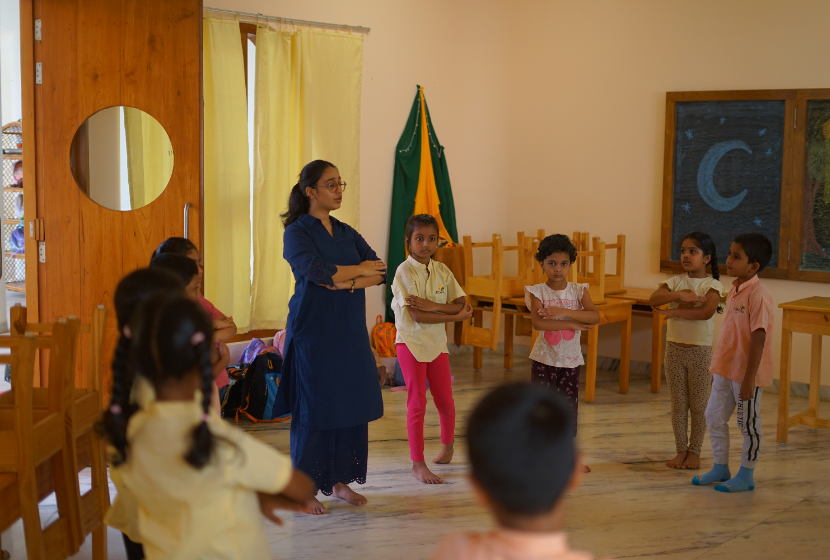
The Dance teacher knows what the children are experiencing in the morning and can allow the movement lesson to resonate with that theme.
The Music teacher may choose songs or rhythms that connect to the same mood.
The Hindi teacher may bring stories, vocabulary or poetry that complement what the children are encountering with their class teacher.
Handwork may offer another way of experiencing the same qualities through the hands.
Suddenly, the children are not simply learning about something.
They are living with the subject.
They meet it through language.
They meet it through movement.
They meet it through music.
They meet it through visual imagination.
They meet it through their hands.
They meet it through stories and conversation.
The same educational experience is therefore strengthened from many different directions.
Experiencing a Subject in All Its Angles
This is one of the subtle strengths of Waldorf education.
A child may encounter a concept intellectually in one lesson, imaginatively through a story, physically through movement and artistically through drawing or music.
Each experience adds another layer.
For example, if the main lesson is exploring a particular culture or geographical region, the Hindi teacher might select a story or poem that enriches the language experience. The Dance teacher might introduce a movement vocabulary connected to the cultural context. Music might bring another dimension through rhythm or song.
The child does not necessarily think:
"Now I am learning Geography."
"Now I am learning Hindi."
"Now I am doing Dance."
Instead, the experiences begin to form a whole.
This is cross-integration, and it helps learning become more meaningful and memorable.
The Mood of the Subject Matters Too
Waldorf education pays attention not only to what children learn, but also to the quality and mood through which they encounter it.
A subject can be approached through wonder, movement, rhythm, beauty, curiosity, humour, challenge or contemplation.
When different teachers understand what the class is experiencing, they can support and deepen that mood.
The class teacher may introduce a theme with wonder in the morning.
The Dance teacher may allow that wonder to become movement.
The music teacher may give it rhythm.
The language teacher may give it words.
The artist may give it colour and form.
The experience becomes richer because the child encounters the same underlying quality through different forms.
Teacher Freedom Does Not Mean Teaching in Isolation
One might ask:
"If Waldorf teachers have so much freedom to create their own lessons, how does the school maintain consistency?"
The answer is that freedom exists within a framework.
Waldorf education has detailed curriculum and developmental guidelines. Teachers need to understand what is appropriate for the age of the child, what capacities are developing and how learning should progress over the years.
Within that framework, the teacher has creative freedom.
The teacher asks:
What does this class need?
What will help them experience this concept?
Which story, song, movement or artistic activity will make this meaningful?
The freedom is therefore not random.
It is informed by knowledge of the child and the curriculum.
The Class Teacher Holds the Larger Picture
Because the class teacher remains with the children for many years, they hold an important thread through the curriculum.
They know what has been introduced.
They know what needs more time.
They know which children need additional support.
They know how the class has responded to different approaches.
This allows the class teacher to work closely with specialist teachers.
The Dance teacher does not have to begin by asking, "What are these children learning?"
The conversation can begin with:
"What are the children experiencing right now?"
That distinction makes collaboration much more meaningful.
Maintaining Quality Through Reflection and Collaboration
Teacher freedom at Swechha is supported by a strong culture of review and mentoring.
Lesson plans are regularly reviewed by teachers and mentors, while mentor observations look at not only how a lesson is planned but how children are actually receiving it. Peer discussions and reviews allow teachers to share experiences, question their approaches and learn from one another.
This continuous cycle of planning, observation, reflection and refinement helps maintain high teaching standards while preserving each teacher's creative freedom.
A Curriculum That Grows With the Child
Consistency also comes from understanding child development.
The curriculum changes as the child changes.
What is appropriate for a six-year-old is not necessarily appropriate for a ten-year-old. As children grow, their relationship with imagination, memory, movement, abstract thinking, social relationships and independent judgment changes.
The curriculum therefore develops with them.
Because the class teacher remains with the class across the primary years, there is an opportunity to understand this development deeply rather than treating every grade as an isolated stage.
Specialist teachers contribute to this same developmental journey through their own subjects.
This creates continuity without monotony.
How Is Teaching Quality Actually Monitored?
A school's consistency cannot be measured simply by asking whether every teacher teaches the same material in the same way.
Instead, we need to ask deeper questions:
- Is the teaching appropriate to the children's developmental stage?
- Is the curriculum being covered meaningfully?
- Are concepts being experienced rather than merely explained?
- Are teachers able to adapt their approach to the children?
- Are different subjects connected where appropriate?
- Does each teacher understand what the children are experiencing elsewhere?
- Are teachers reflecting on their lessons and receiving feedback?
- Are children developing steadily in their capacities?
At Swechha, classroom observation, teacher reflection, curriculum planning and collaboration help us look at these larger questions.
The Teacher's Individuality Is Part of the Education
A Waldorf teacher is not simply a person delivering a standardised programme.
The teacher's individuality is part of what they bring to the children.
One teacher may have a gift for storytelling.
Another may have a deep musical sensitivity.
Another may bring exceptional creativity to movement.
Another may have a wonderful ability to make language come alive.
Rather than removing these differences in the name of consistency, Waldorf education can use them as strengths.
The important thing is that these individual gifts operate within a shared understanding of the child and the curriculum.
A Whole Made of Many Parts
Perhaps the best way to understand consistency at a Waldorf school is to think of it as an orchestra.
Each instrument sounds different.
The violin should not sound like the flute.
The percussion should not sound like the piano.
But they are all contributing to the same piece of music.
In the same way, the main lesson, Hindi, Dance, Music, Handwork and other subjects each have their own character.
Their value lies partly in allowing children to encounter the world from different perspectives.
When teachers understand one another's work, these perspectives begin to form a coherent whole.
What This Means for Families
For families exploring a Waldorf school in Vizag, it is useful to look beyond the question of whether every classroom follows an identical method.
Instead, ask:
Do the teachers understand one another's work?
Does the curriculum have a clear developmental direction?
Does the school encourage teachers to collaborate?
Is there continuity in the child's educational journey?
Are different subjects allowed to enrich one another?
At Swechha, a Waldorf Inspired school, we believe the answer to these questions matters more than whether every teacher uses the same lesson plan.
A child should experience education as a connected journey rather than a collection of disconnected subjects.
Consistency Without Uniformity
Ultimately, consistency in teaching quality does not mean making every teacher teach in the same way.
It means creating a school where teachers share a common understanding of:
the child,
the developmental stage,
the curriculum,
the purpose of each subject,
and the larger educational journey.
Within that shared framework, teachers have the freedom to be creative.
The class teacher carries the long-term thread.
The specialist teachers add their own perspectives.
The subjects speak to one another.
And the child experiences learning through many different doors.
This is what we strive to create at Swechha, Vizag's first Waldorf school—an education that is consistent in its purpose and developmental direction, while remaining alive, creative and responsive in every classroom.
For families looking for a primary school in Vizag, this distinction is worth considering.
A consistent education does not have to look the same everywhere.
Sometimes, the deepest consistency comes from giving children many different ways to experience the same world.