Waldorf School in Visakhapatnam: How Swechha Is Different from Regular Schools
Waldorf School in Visakhapatnam: How Swechha Is Different from Regular Schools
Table of contents:
- Introduction
- A Philosophy That Starts With the Child, Not the Curriculum
- What a Waldorf Kindergarten Actually Looks Like
- The Academics Do Come — Just At the Right Time
- Two Campuses Rooted in the Same Thinking
- Why This Conversation Is Worth Having
Some schools teach children what to think. A few teach them how to think. And then there are rare ones that go a step further — they let children grow into thinking for themselves, at their own pace, without rushing the process.
That third kind is harder to find. But it exists in Visakhapatnam, and it goes by the name Swechha.
Before getting into what makes Swechha stand apart, it helps to understand why the question even matters. Schools in India have largely followed the same script for decades — structured syllabi, early academics, competitive benchmarks. It works for some children. But for many, it quietly chips away at something harder to measure: curiosity, confidence, and the simple joy of discovering something new. Once that's gone, no rank or report card brings it back.
This is the gap that Waldorf education aims to address — and why Swechha brings it to Visakhapatnam.
A Philosophy That Starts With the Child, Not the Curriculum
Waldorf education was developed by Rudolf Steiner in 1919, and it rests on one foundational belief — childhood is not a rehearsal for adulthood. Each phase of a child's development has its own needs, its own rhythm, and its own kind of intelligence. Treating a six-year-old like a small adult who needs to start performing academically isn't ambitious. It's just out of sync with how children actually grow.
At Swechha, the best Waldorf school in Visakhapatnam, this isn't just philosophy kept in a frame on the wall. It shows up in every part of how the school runs — the classroom setup, the daily rhythm, the way teachers engage with children, and even the way the campuses are designed.
What a Waldorf Kindergarten Actually Looks Like
Walk into Swechha's Waldorf kindergarten in Visakhapatnam and the first thing you'll notice is that it doesn't look or feel like a typical preschool. There are no rows of desks. No flashcards on the board. No performance charts with star stickers.
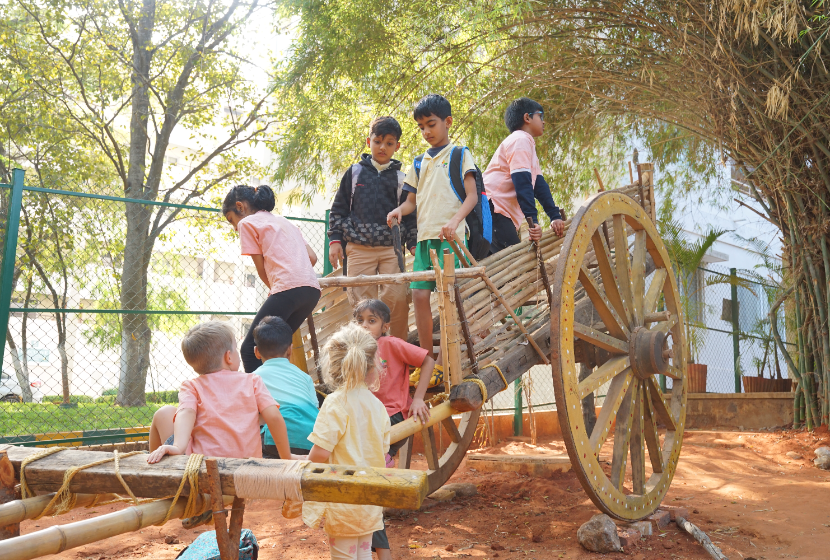
What you'll find instead is a warm, home-like space where children between 3 and 6 years old are cooking, painting, gardening, hearing stories, and working with their hands. The classrooms are mixed-age — a three-year-old and a five-year-old learning alongside each other — which mirrors how children actually learn in real life: by watching, imitating, and participating.
This is the heart of early childhood education in Visakhapatnam done the Waldorf way. Children at this age learn most powerfully through imitation. When a teacher kneads dough with care, or sweeps a floor with intention, children follow naturally. Through that, they build motor skills, language, concentration, and a sense of responsibility — organically, without being drilled.
None of this is filler time. This is the actual work of early childhood. And protecting this phase, rather than rushing past it, is what sets Swechha apart from conventional schools.
The Academics Do Come — Just At the Right Time
A common question that comes up: what about formal learning? When does that begin?
At Swechha, Grade 1 starts after a child turns six. And children who've had those early years of play, rhythm, and imagination don't arrive at formal learning behind — they arrive ready. Genuinely ready. With better focus, stronger language, richer social skills, and something most schools can't manufacture: a real appetite for learning.
Through primary and middle school, subjects aren't taught in isolation. Mathematics, language, science, history — all of it is introduced through what Swechha calls a "living" approach, woven together with music, movement, art, craft, and storytelling. A child studying history might act it out. A child learning fractions might find them first in music. Knowledge taught this way doesn't just get memorized — it gets understood, connected, and remembered.
The benefits of Waldorf education in Vizag show up not just academically, but in how children carry themselves. They learn to think independently, sit with complexity, and find meaning in what they do — things that competitive coaching simply cannot build.
Two Campuses Rooted in the Same Thinking
Swechha runs two campuses in Visakhapatnam. The first is at Rushikonda, within the GITAM University campus — spacious, green, and designed to give children room to breathe and explore. The second is at Pedda Waltair, closer to the city centre, specifically opened to cut down long commutes for younger children.
The Pedda Waltair campus sits in a home-like building surrounded by greenery, a small pond, and the sound of children at play. It wasn't designed to look impressive in photos. It was designed to feel safe and familiar to a three-year-old stepping away from home for the first time. That distinction matters more than it sounds.
Why This Conversation Is Worth Having
Swechha isn't trying to be the school with the longest merit list or the most competitive entrance process. What it's doing is something quieter and, in many ways, more ambitious — building children who are genuinely well, deeply curious, and capable of thinking for themselves.
Whether you're a parent exploring options, an educator curious about alternative approaches, or simply someone who's ever wondered if there's a better way to do school — Swechha makes a compelling case.
The best Waldorf school in Visakhapatnam isn't just a different kind of school. It's a different understanding of what school is for. And in a city that's clearly ready for that conversation, Swechha is the place where it's already happening.