Why is Every Lesson Artistic in a Waldorf Grade School
Why is Every Lesson Artistic in a Waldorf Grade School
Table of contents
- Introduction
- The Philosophy Behind the Paint Brush
- What Does Art Actually Look Like in Our Classrooms?
- Why Does This Matter for Your Child?
- The Balance Between Art and Academics
- What We See Every Day
- The Long View
There's something magical about watching a child learn multiplication through rhythmic clapping or understanding geometry by drawing their own patterns with colored pencils. Traditional classrooms often treat art as an afterthought, a Friday afternoon activity when the "real" work is done. But what if art wasn't separate from learning? What if it were the very foundation of how children absorb knowledge?
At Swechha, we've witnessed something remarkable. Children don't just memorise the water cycle. They paint it, act it out, sculpt it with clay, and sing songs about clouds and rivers. The result? They don't forget it. Ever.
The Philosophy Behind the Paint Brush
In our system of Waldorf education in Visakhapatnam, what parents often discover is built on a simple truth: children think in pictures, not abstracts. Before they can process dry facts and figures, they need to experience concepts through their senses. Rudolf Steiner, who founded this approach in 1919, understood that the hands, heart, and head must work together for genuine understanding.
When we talk about artistic learning in grade school, we're not suggesting children become painters or musicians by profession. We're recognising that creativity is the doorway through which all knowledge enters a young mind. A six-year-old doesn't naturally grasp what "evaporation" means. But when they witness through water colours how blue dissolves and rises, they experience and feel the mood of water turning to vapour.
What Does Art Actually Look Like in Our Classrooms?
Walk into any of the grade-wise learning schools in Visakhapatnam following the Waldorf approach, and you'll notice something unusual. There are no boring worksheets pinned to walls. Instead, you'll find student-created main lesson books bursting with illustrations, hand-drawn maps, and stories written in their own evolving handwriting.
Every morning starts with movement. Children don't slump into chairs for eight hours. They recite poems with gestures, practice form drawing that strengthens their motor skills, and engage in rhythmic movements that prepare their brains for math patterns later.
Math lessons become adventures. Roman numerals aren't just memorised; children draw them like ancient scribes, feeling the weight of each symbol. Times tables are learned through jumping rope and ball games. Fractions are explored by folding paper, cutting apples, and sharing equally among friends.
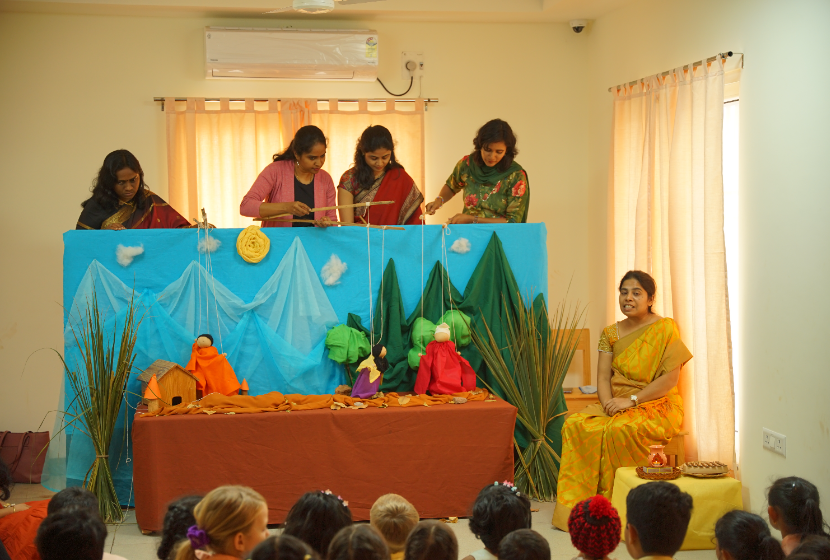
Language arts transform into storytelling theatre. Grammar isn't a list of rules to memorise. Nouns become means of naming while verbs come through a game of action charades. Adjectives add description to their imagination. Children act out sentences, draw their compositions, and speak them aloud before ever writing them down.
Science comes alive through observation and wonder. Before learning the technical names of leaf parts, children grow plants, observe shoots and leaves, draw & paint them, write poems on the patterns, and create nature journals. They're not passive receivers of information. They're active investigators.
Why Does This Matter for Your Child?
The Waldorf grade school education in Vizag approach addresses a problem many parents notice: children can recite facts but don't truly understand them. They can copy answers but struggle with creative thinking. They are not eager to learn because learning feels like a burden rather than an adventure.
Artistic learning in a Waldorf grade school solves this disconnect. When a child studies ancient civilisations by baking bread the way Egyptians did, building miniature pyramids, and creating hieroglyphic art, history stops being dates on a page. It becomes real, tangible, memorable.
Children who learn through art develop stronger problem-solving skills. They're not waiting for someone to tell them the "right" answer. They're experimenting, adjusting, trying again. A child learning to mix colours to get just the right shade of sunset orange is practising persistence, patience, and observation.
These skills transfer to forming connections across subjects. The child who learned fractions by dividing a clay pizza among classmates understands division more deeply than one who only filled out worksheets. The one who acted out the life cycle of a butterfly grasps transformation in ways a textbook diagram never achieves.
The Balance Between Art and Academics
Some parents worry: if everything is art, are children actually learning academic content? The answer is a resounding yes. Waldorf grade schools in Visakhapatnam follow developmental stages carefully. Artistic methods don't replace rigour; they enhance it.
By Grade 3, children are writing their own books, complete with illustrations. By Grade 5, they study botany with detailed scientific drawings. By Grade 7, they explore complex mathematical concepts through geometric art. The artistic element does not replace academic concepts; it deepens.
What changes is the child's relationship with learning. Instead of viewing education as something imposed from outside, they experience it as something they create. Their main lesson books aren't textbooks someone else wrote. They're personal records of discovery, filled with their own insights and interpretations.
This ownership changes everything. Children don't study for tests and then forget. They internalise knowledge because they've processed it through multiple channels: visual, kinesthetic, auditory, and emotional.
What We See Every Day
At Swechha, we watch children arrive excited to learn. Not because we've gamified it or offered rewards, but because learning itself has become joyful. A Grade 3 student practices writing by creating illustrated stories about their weekend. A Grade 4 class explores local history by sketching maps of Visakhapatnam's coastal areas.
The proof appears in unexpected moments. A child explains cloud formation using their hands to show movement. Another connects mathematical patterns to the rangoli designs they drew in art. These aren't memorised responses. These are genuine understandings.
Parents often tell us their children come home full of stories instead of complaints. They hear about the dragon from the Norse mythology tale, not just that they "did reading." They see the careful work in handmade books, not just filled-in worksheets.
The Long View
Grade-wise learning schools in Visakhapatnam vary widely in their approaches, but what makes the Waldorf method distinct is its long game. We're not optimising for next month's test scores. We're nurturing capabilities children will use for life: imagination, critical thinking, genuine curiosity, and the confidence to approach problems creatively.
When every lesson contains art, children learn that there are multiple ways to understand the world. They learn to trust their observations, value their unique perspectives, and express complex ideas through various media. These aren't just school skills. These are human skills.
So yes, children at Swechha learn reading, writing, and arithmetic. But they learn them as artists learn: through practice, experimentation, revision, and the deep satisfaction of creating something meaningful. That's not a nice addition to education. That's what education should be.